Part 2 of the Japanese Pattern Book Sew Along
The first thing we need to do is find out what size to make.
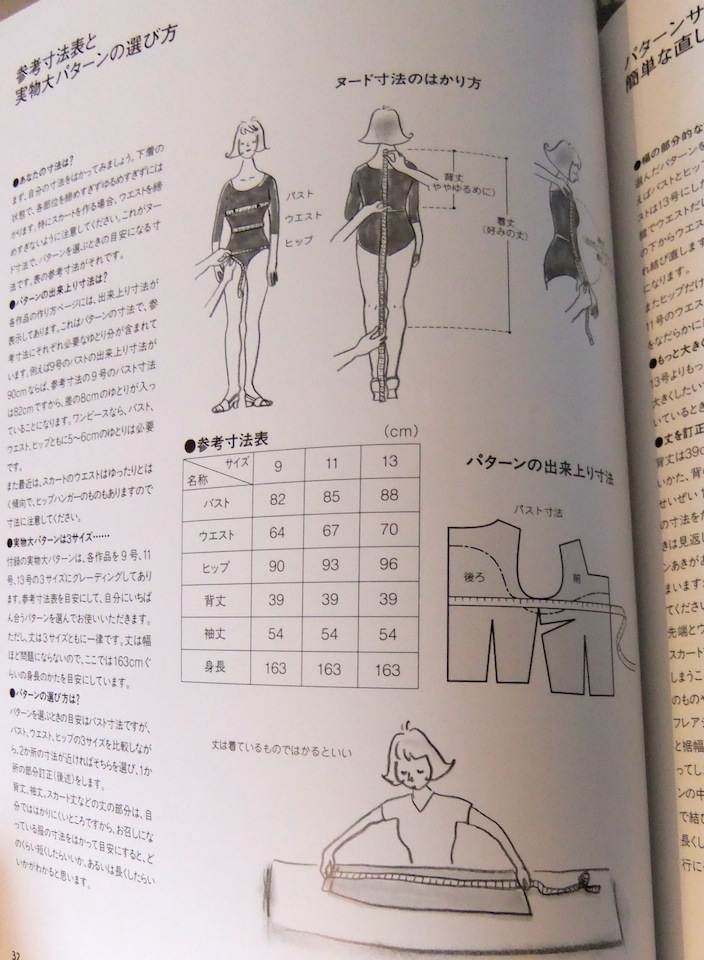
There should be a size table somewhere in your book. More often than not it appears after the photos and before the pages of instructions. But it could appear after the instructions or even on the individual instructions page for your garment.
There is a good guide to measuring yourself here. Keep a note of your measurements to save you doing it again next time.
In Feminine Wardrobe, the page looks like this:
Along the top are the different sizes on the pattern sheet. These can be the usual S, M L but can also be numbers such as 7, 9, 11. I often make the mistake of presuming that compared to a petite Japanese figure I am a massive giant, but more often than not, I will be somewhere in the middle of the chart as I am in the UK. I do have a long back and many tops from Japanese books can stop around the waist, so I usually end up making them a little longer.
By consulting with my translation sheet, I can see that down the side, the table reads as follows:
I am closest to large, I was expecting to be a medium, but I’ll go with what the table says. I'm not sure what the last measurement is, I think it is height judging by the size.
Whilst I normally would avoid writing in a book, I have started writing notes, translations, sizes used to save myself going through the whole process next time I use the book. Translations in particular I note down (especially on the pattern sheet) because however much I may think I will remember a translation, as soon as I look away from the page it is forgotten.
Some books have a picture with the different measurements written on them (e.g. Simple Chic below) so that even saves you the bother of doing a translation.
This book has an extra page before the individual instruction pages, I’ve not seen this before. But looking at the pictures it appears to be grouping the garments together that are a variation on the same pattern.
My top (C2) is part of a happy family that includes a dress (C1) and another top (C3). There is a load of text here which I won’t begin to try and translate, but looking at the table, and the pictures, I think it is explaining the different lengths of the bodice of these 3 variations. δΈ means height. It also seems to be showing the different sleeves involved, θ’ means sleeve.
I don’t think this page includes any extra info I need, but I may well be wrong and come back to it later. There is a certain amount of trial and error when using a book in a language you don’t understand!
Here is my secret about this books, I probably translate 5 - 10% of the instruction page(s) because everything I need to know is shown in the pictures. Sometimes there is the odd detail where I will try and figure it out, but a lot of the time, I don't need it.
Going to the page in the book for my top, there are some more details there I need to think about. I’m a little shocked to see it is just one page, as usually there are at least 2 and it’s a fairly complicated top.
But further investigation shows that it shares some instructions with the first variation of this pattern (C1) on the previous page, panic over.
There may be a materials list on this page. Mine is blissfully brief;
You can normally piece together several different characters to translate a term. So here I have heavy-weight and interfacing. I take surface fabric to be garment fabric (as opposed to lining fabric).
The pattern layout diagram looks like this, familiarise yourself with all the different pattern pieces. This diagram includes useful info such as some seam allowances, although for most of the pieces it is not shown, so I am going to use 1cm, sometimes I use 1.5cm. Japanese pattern sheets do not include seam allowances.
I can see that the fabric is folded in half, it is 110cm wide and 170 -180cm long. I can also see which side is the fold, where to place the pattern pieces, but also some of the pieces are shaded. This could show the right or wrong side of the fabric but in this case it is because these pieces are cut from interfacing. This character ζ shows you how many to cut, so 2 ζ means cut 2.
From the diagram and conferring with my translation sheet, I can see that I need to cut;
4 sleeves (each sleeve has 2 layers) 2 are cut on the bias
1 bodice front cut on the fold
1 bodice back cut on the fold
1 back neck facing, cut from interfacing
1 front neck facing, cut from interfacing
Next up, deciphering the pattern sheet and tracing off your pieces.
Posts in this series:
1. Sewing from Japanese Craft books - what you will need and an overview
2. Sizing and figuring out the instruction page
Thursday, 10 March 2011
2. Sizing and figuring out the instruction page
Labels:
Japanese book sew along
Sunday, 6 March 2011
Paper craft
My attempts so far the the easiest (and quickest) projects from Stylish Papercraft. I'd quite happily spend all weekend doing this, but apparently my children need feeding and entertaining.
It's great fun, I'd recommend it, you need plenty of supplies, a lack of double-sided sticky tape meant I couldn't make these birds straight away. And you need spray glue too, which is brilliant stuff.
There are loads more projects, I really want to make the bird house form the cover of Papercrafting In No Time but I think that's one for when I have a bit of peace and quiet.
Labels:
paper crafting
Thursday, 3 March 2011
1. Sewing from Japanese Craft books - what you will need and an overview
So, before we start the sew along, here are a few things you will need;
- Your book (and if you bought it from M is for make, your translation sheet)
- Pencil, ruler, rubber
- Masking tape
- Paper suitable for tracing a pattern onto
(I use this paper from Morplan, but have a look on the comments from this post for some other suggestions. It needs to be transparent enough to see the lines of the pattern through and wide enough to fit your larger pieces on, or you can stick multiple sheets together.)
- Some calico - we will talk about quantities later in this post
(roughly £2 a metre from the high street or some old fabric you no longer want such as a sheet or duvet cover.)optional:
- a tracing wheel to trace out your pattern (I prefer not to use these as I find it harder to be accurate and more time consuming)
- a pattern master (not essential but really useful for tracing off curves from a pattern and adding seam allowances)
But first off, I thought I would give you a summary of the whole process so you know what to expect. I will cover all of this in more detail in the sew along.
An overview of sewing from Japanese pattern books
Layout
Japanese books tend to follow a similar layout. They start off with pages of beautiful photos showing the garments you can make. Then follows the instructions, and at the back, the pattern sheet.
On the pages with the photos of the garments, you will glimpse tantalising bits of English. Each garment is usually referenced with a letter and the page on which to find instructions. This garment reference letter will also be used on the pattern sheet. You can see the instructions for my party blouse are on page 51 (but there is no reference letter).
Summary page
When you get to the end of the photos and before the instruction pages, you will often find a summary page containing the size table (this can also appear on the individual garment page or at the back of the book, but it should be somewhere and look a bit like this). We will translate the measurements later.
Instructions page
Turning to the relevant page for the garment you want to make, you will find a simple picture of it, the reference letter/number (mine is C2), a cutting layout diagram, maybe some tables for sizing or fabric/materials list, some blurb, and then simple line drawings to show each step of construction.
The cutting layout diagram includes useful information such as some seam allowances. It will also show you how much fabric you will need. When choosing your garment, spend a bit of time looking through this page, understanding the sequence of how it all goes together.
At this stage you can figure out how much calico you will need. I always make a rough version first to check I have the right size, make any fit adjustments to the pattern and practice making the garment. So from my book I can tell that I will need 180cm of fabric that is 110cm wide. The fabric in this picture is folded in half.
The picture of the garment will be numbered and each of these is the different steps in which it will be put together (in order). You should be able to reference the more detailed diagrams of individual steps against this picture. Not all steps, for example sewing together the shoulders or sides, will have a detailed picture as they don't need one.
Pattern sheet
The pattern sheet is at the back of the book, ease it out carefully or cut it off as close to the book as you can. Open it up and try not to be scared. Pattern sheets that contain multiple patterns overlaid can be very daunting. But don't be, once you have had a chance to understand it, they are fine.
You will trace off the required pieces of your pattern, label all the important markings and information (this will require some translation). Once this is done you will add seam allowances to your pattern piece as they are not included.
All done, then you will sew it all together as per the instructions.
So there is your overview, go off, get what you need and we'll meet back in (about) week to figure out what size to make and further understand the instruction page.
Labels:
Japanese book sew along,
part 1
Subscribe to:
Comments (Atom)


